
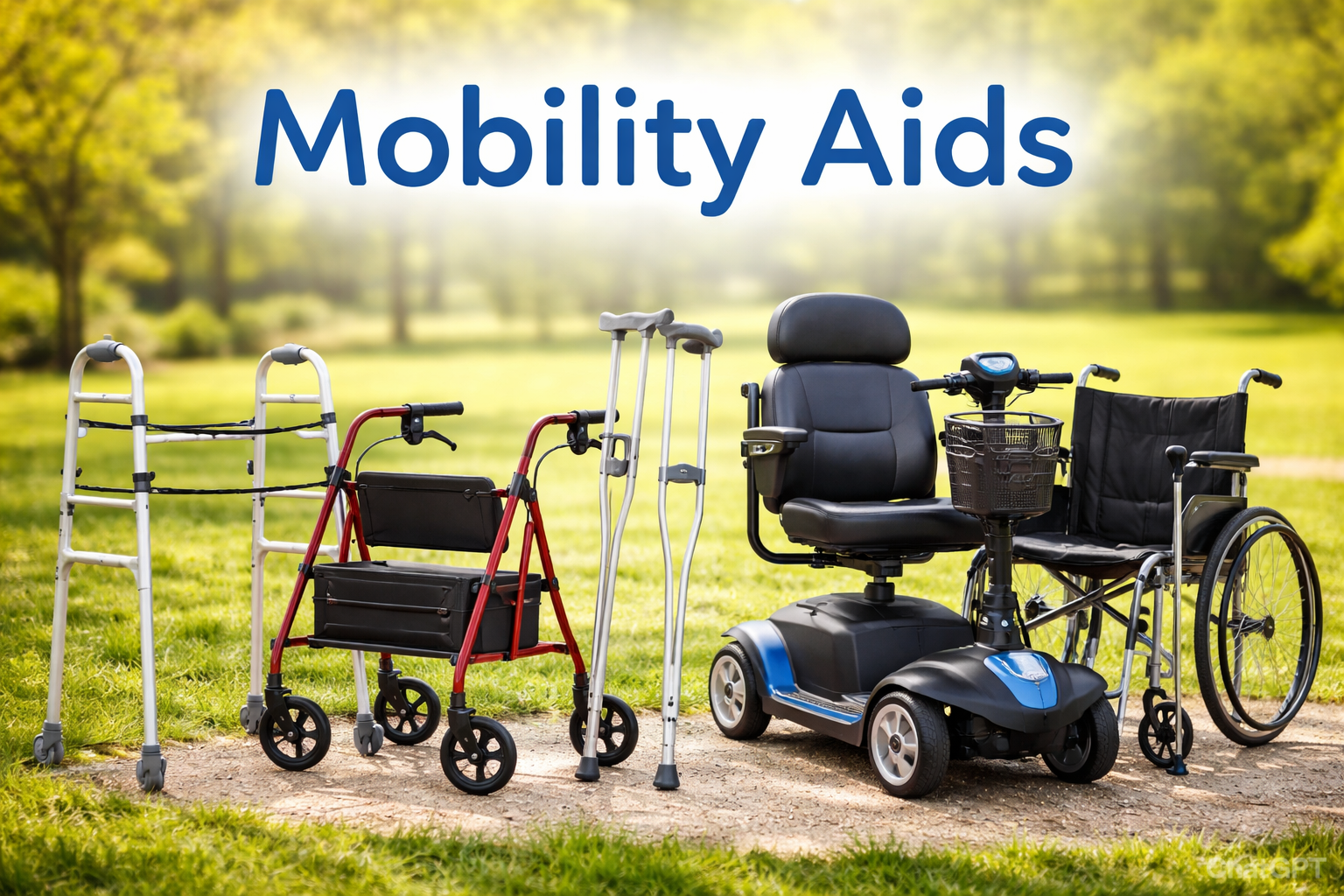
Mobility is not just about walking from one room to another. It is about the freedom to live life on your own terms — to go where you want, do what you love, and move through the world with confidence and dignity. When mobility becomes a challenge — whether due to age, injury, illness, or disability — the effects extend far beyond physical movement. Independence diminishes. Emotional wellbeing suffers. The sense of self can quietly erode.
WHAT ARE MOBILITY AIDS?
A mobility aid is any device designed to assist individuals who experience difficulty walking, balancing, or moving independently. Formally classified as assistive technology for mobility, these devices are central to rehabilitation practice, disability management, and elderly care worldwide.
Mobility aids are not a sign of weakness or defeat. They are clinically proven tools that restore — either temporarily or permanently — what injury or illness has affected: the ability to move safely and confidently through daily life. Importantly, no single device suits every person. Effective prescription depends on a thorough individual assessment that accounts for diagnosis, functional capacity, lifestyle, and environment.
WHO Can Take BENEFITS FROM MOBILITY AIDS?
---------------------------------
Mobility challenges affect people across all ages, backgrounds, and medical histories. Common groups who benefit from mobility support include:
-
Elderly individuals experiencing age-related changes in balance, muscle strength, and coordination who need reliable support to remain safe and active.
-
Post-surgical patients recovering from hip or knee replacements, spinal procedures, or lower limb operations who require appropriate walking aids during rehabilitation.
-
People living with neurological conditions such as stroke, Parkinson's disease, multiple sclerosis, cerebral palsy, or spinal cord injuries, who need specialised adaptive equipment tailored to their movement patterns.
-
Trauma and accident survivors who have experienced fractures, limb injuries, or amputations and are working to rebuild functional independence.
-
Individuals with congenital disabilities who have lived with mobility challenges from birth and benefit from custom-designed solutions that support an active and fulfilling life.
-
People managing chronic conditions including arthritis, osteoporosis, or muscular dystrophy, where progressive joint and muscle changes affect walking ability over time.
Whatever your situation, an appropriate mobility solution exists. The right clinical assessment will identify it.
TYPES OF MOBILITY AIDS: A COMPLETE GUIDE
-----------------------------------------
Understanding the range of available devices helps you engage more meaningfully with your clinician and make a more confident, informed decision.
1. CANES (WALKING STICKS)
Canes are the most widely used walking aids. They provide supplementary balance and weight distribution for individuals with mild mobility challenges, joint pain, or minor balance difficulties.
A standard single-point cane is lightweight and suitable for mild balance support. A quad cane, featuring four contact points on the ground, offers greater stability and is particularly useful for stroke survivors or those with significant balance impairment. An offset cane positions the handle directly over the shaft, improving weight distribution and reducing strain on the wrist and hand during prolonged use.
Best suited for: Mild arthritis, early-stage balance difficulties, light post-surgical recovery, and elderly individuals who need minimal support in daily life.
Clinical note: Cane height is critical. An incorrectly sized cane can worsen posture and increase fall risk rather than reduce it. Height should always be set by a qualified clinician, not estimated.
2. CRUTCHES
Crutches are used when the lower limb cannot bear weight — most commonly following fractures, ligament injuries, foot surgeries, or lower leg trauma.
Axillary (underarm) crutches are the traditional option, typically used during short-term recovery. Forearm (elbow) crutches, also known as Lofstrand crutches, are preferred for longer-term use because they allow greater arm freedom and place less strain on the axillary region. Platform crutches are prescribed when the wrist or hand cannot bear weight, providing a forearm platform to lean on instead.
Best suited for: Short and long-term non-weight-bearing recovery, lower limb fractures, and post-operative rehabilitation.
3. WALKERS AND ROLLATORS
Walkers provide a stable four-point base of support for individuals who need more than a cane but do not yet require a wheelchair. They are among the most frequently recommended walking aids for older adults and post-surgical patients.
Standard walkers have no wheels and are lifted and placed forward with each step. They offer maximum stability but require greater upper body effort and are best suited for indoor or slow-paced use.
Two-wheel walkers have front wheels for smoother forward movement while the rear legs provide resistance to prevent rolling when weight is applied.
Rollators (four-wheel walkers) represent the most advanced walking frame option. Equipped with four swivelling wheels, ergonomic handles, hand brakes, and a fold-down seat for resting, modern rollators are lightweight, foldable, and available in both indoor and outdoor variants. They are particularly valued by individuals who need to cover longer distances or who tire quickly.
Best suited for: Elderly individuals, Parkinson's patients, post-stroke recovery, fatigue-related conditions, and anyone requiring stable walking support across varied environments.
4. WHEELCHAIRS
A wheelchair is recommended when walking is significantly limited or no longer safe or feasible. Today's wheelchairs span a wide range of designs, from lightweight manual frames to sophisticated powered systems.
Manual wheelchairs are propelled by the user's own arm strength or by a caregiver. They are lightweight, foldable, and well suited to part-time or indoor use.
Self-propelling wheelchairs feature larger rear wheels designed for independent use, allowing the user to wheel themselves without caregiver assistance.
Powered (electric) wheelchairs are battery-operated and controlled by a joystick or alternative input device. They are essential for individuals with limited upper body strength, quadriplegia, or progressive neuromuscular conditions such as ALS where arm function is reduced.
Tilt-in-space and reclining wheelchairs are specialist clinical systems designed for individuals who cannot reposition themselves and require regular pressure relief and postural support.
Sport and active wheelchairs are ultra-lightweight, performance-engineered frames for users who participate in wheelchair sports, work in demanding physical environments, or lead highly mobile lifestyles.
Best suited for: Full-time or part-time use across a wide range of conditions including spinal cord injury, stroke, amputation, degenerative neuromuscular conditions, and elderly users who can no longer walk safely.
5. MOBILITY SCOOTERS
Mobility scooters are battery-powered personal vehicles designed for individuals who can sit upright independently but struggle with walking over longer distances. They are particularly popular for outdoor use — shopping, community access, leisure outings, and travel.
Available options include compact travel models that fold for transport, mid-size pavement scooters for daily community use, and heavy-duty all-terrain models for outdoor or rural environments.
Best suited for: Elderly individuals, people with fatigue-related conditions such as MS or fibromyalgia, and those with cardiac or respiratory conditions that limit walking endurance.
6. PROSTHETIC LIMBS (ARTIFICIAL LIMBS)
Prosthetics are custom-designed artificial limbs that replace a missing arm, leg, hand, foot, or partial limb — either following amputation or for individuals with a congenital limb difference.
Available prosthetic solutions range from body-powered and myoelectric systems to high-performance, activity-specific and carbon fibre prosthetic legs, all custom-fitted to the individual's anatomy and rehabilitation goals. Advances in prosthetic technology now make it possible for many users to return to work, sport, and the physical activities that define an active, independent life.
A well-fitted, correctly managed prosthetic limb is not merely functional — it is transformative.
Best suited for: Amputees, individuals with limb difference, and anyone seeking to restore lost limb function through an evidence-based, clinically managed prosthetic programme.
7. ORTHOSES (SUPPORTIVE BRACES)
An orthosis is a custom or prefabricated brace designed to support, align, protect, or correct a joint or limb. Unlike a prosthesis, an orthosis works with an existing — but weakened, painful, or unstable — body part.
Common orthotic devices include ankle foot orthoses (AFOs) for foot drop and neurological gait disorders; knee orthoses for ligament instability and osteoarthritis; spinal orthoses for scoliosis, spinal fractures, or post-surgical support; and hand and wrist orthoses for nerve injuries, rheumatoid arthritis, and post-stroke spasticity.
Best suited for: Any individual with joint instability, chronic pain, neurological motor dysfunction, or post-surgical correction needs affecting the spine, upper limb, or lower limb.
8. SPECIALISED AND ADVANCED MOBILITY EQUIPMENT
Beyond standard devices, a range of more specialised equipment is available for complex mobility needs. This includes stairlifts for home accessibility; ceiling hoist and transfer systems for non-ambulatory patients; standing frames and gait trainers for neurological rehabilitation; and custom seating and postural support systems for complex wheelchair users.
These solutions are typically prescribed following a detailed clinical assessment and are often coordinated alongside home environment modifications.
THE FOUR PILLARS OF MOBILITY
-----------------------------
Healthcare professionals assess mobility across four core domains. Understanding these pillars helps identify precisely where support is needed and which intervention will make the greatest practical difference.
Bed Mobility refers to the ability to move, reposition, and transfer within a bed independently. This is often the first area affected by neurological conditions, post-surgical recovery, or severe physical weakness. Bed rails, turning frames, and transfer boards address this domain.
Transfers describe the ability to safely move between surfaces — from bed to wheelchair, wheelchair to toilet, or chair to car seat. Transfer boards, hoist systems, and appropriate wheelchair positioning all support safe, dignified transferring.
Ambulation is the clinical term for walking — whether independently, with a walking aid, or with caregiver support. Canes, crutches, walkers, orthoses, and prosthetics are the primary tools that support ambulation.
Wheelchair Mobility encompasses independent or assisted use of a manual or powered wheelchair for functional daily movement, including indoor navigation, community access, and pressure management.
A thorough clinical assessment will evaluate all four pillars and, where needed, design a mobility support plan that addresses each level individually.
KEY FACTORS THAT AFFECT MOBILITY
----------------------------------
Mobility is shaped by a complex combination of physical, neurological, psychological, and environmental factors. Understanding these contributors guides the clinical team toward the most effective solution.
Age-related changes including reduced muscle mass, bone density, balance, and joint flexibility are among the most common reasons people seek mobility support. Appropriate walking aids and fall prevention strategies can make a significant difference to daily safety and confidence.
Musculoskeletal conditions such as osteoarthritis, rheumatoid arthritis, osteoporosis, and joint replacements directly affect walking comfort and stability. Custom orthotics and mobility aids can substantially reduce pain and improve function.
Neurological conditions including stroke, Parkinson's disease, multiple sclerosis, and spinal cord injuries affect the neural pathways that control movement. Specialist orthotics, gait-specific mobility aids, and prosthetics are key interventions in this category.
Post-surgical recovery requires temporary mobility support while the body heals. Selecting the appropriate device for each phase of recovery prevents complications and supports faster rehabilitation.
Environmental barriers — steps, uneven surfaces, narrow doorways, and limited accessible transport — restrict mobility independence even when the right device is in place. Home assessment and environmental modification recommendations should always accompany device prescription.
Psychological factors including fear of falling, reduced confidence, anxiety, and depression frequently accompany mobility challenges. Left unaddressed, these lead to activity avoidance and physical deconditioning over time. Effective rehabilitation addresses both the physical and emotional dimensions of recovery equally.
HOW THE RIGHT MOBILITY SOLUTION IS SELECTED
--------------------------------------------
Choosing a mobility aid should never involve simply selecting a device from a catalogue. A thorough clinical assessment process is the only reliable way to ensure that a recommendation is appropriate, safe, and suited to real-world daily life.
A robust assessment process includes:
- A detailed clinical evaluation of medical history, diagnosis, and physical capabilities
- A functional mobility assessment measuring balance, strength, walking pattern, and endurance
- A lifestyle and goals conversation that explores home environment, daily routines, and the activities that matter most to the individual
- A home and environment review to confirm that the recommended device works in the spaces where the person actually lives
- A fitting and trial session, where the device is tested with professional guidance before any final commitment is made
The clinical team involved should include certified prosthetists, orthotists, and rehabilitation specialists working as a coordinated multidisciplinary unit — ensuring that every aspect of the individual's mobility needs is addressed by the right expert.
BENEFITS OF USING THE RIGHT MOBILITY AID
-----------------------------------------
When the right device is correctly fitted and supported by appropriate rehabilitation, the benefits extend far beyond simply being able to walk. Patients who receive well-matched mobility solutions consistently report:
-
Restored independence — the ability to move through their home, community, and daily routines without constant reliance on caregivers or family members.
-
Reduced fall risk — a critical outcome, particularly for elderly patients and those with neurological conditions where falls carry serious and sometimes irreversible consequences.
-
Reduced pain and joint stress — because the right mobility aid redistributes load away from damaged or painful joints, making movement more comfortable and sustainable over time.
-
Improved mental health and confidence — mobility and emotional wellbeing are deeply interconnected. When people can move freely again, anxiety typically decreases, social participation increases, and measurable improvements in quality of life follow.
-
Better rehabilitation outcomes — appropriate mobility aids used during recovery support the healing process and reduce the risk of secondary complications arising from prolonged immobility.
-
Participation in meaningful activities — from attending family gatherings and returning to work, to pursuing hobbies and travelling. True mobility independence means being fully present in your own life again.
CARING FOR YOUR MOBILITY AID
------------------------------
Proper maintenance ensures that your device continues to perform safely and reliably. The following care principles apply across all major device types.
Inspect your device regularly for signs of wear, particularly rubber ferrules (cane and walker tips), wheels, brakes, and seat upholstery. Replace worn components promptly — degraded tips and faulty brakes are a leading cause of preventable falls.
Keep all moving parts clean and free from debris, particularly wheel axles and brake mechanisms on rollators and wheelchairs.
Charge electric wheelchair and scooter batteries according to the manufacturer's schedule. Allowing batteries to fully deplete on a regular basis significantly shortens battery life.
Store mobility aids in a dry, temperature-appropriate environment. Extremes of heat, cold, or moisture can damage frames, upholstery, and electronic components.
Schedule an annual professional service to ensure your device remains correctly adjusted, structurally sound, and optimally set up for your current level of need — which may have changed since the original prescription.
FREQUENTLY ASKED QUESTIONS
----------------------------
How do I know which mobility aid is right for me?
The only reliable way to identify the right device is through a professional clinical assessment. The appropriate choice depends on your diagnosis, functional ability, lifestyle, home environment, and personal goals — all of which are unique to you. Self-selecting a device without clinical input risks choosing something that fails to meet your needs or, worse, that increases your risk of falls or injury.
Do I need a referral to see a mobility specialist?
Most reputable mobility clinics, including Miembros Oasis Mobility Clinic, welcome both self-referrals and referrals from GPs, specialists, and other healthcare professionals. You do not need a doctor's letter to begin the assessment process.
Can mobility aids be provided for children?
Yes. Paediatric mobility solutions are available for children of all ages — from specialised walking frames and paediatric orthotics to custom wheelchairs and prosthetic limbs. Paediatric devices are designed to accommodate growth and to support developmental milestones alongside functional mobility.
Are mobility aids covered by insurance or government funding?
Many mobility aids qualify for coverage through health insurance, disability benefit schemes, veteran support programmes, or workplace injury compensation. Eligibility varies by device, condition, and country or region. A mobility specialist or clinic team can advise on applicable funding pathways and assist with the application process.
How often will I need to replace or upgrade my device?
This depends on device type and intensity of use. Walking aids such as canes and crutches may only require rubber tip replacement over many years. Wheelchairs and scooters typically benefit from annual servicing and replacement every three to five years. Prosthetics and orthoses are reviewed regularly and adjusted or replaced as the individual's body and functional needs evolve.
TAKING THE NEXT STEP
---------------------
Whether you are just beginning to explore mobility aid options, looking to upgrade an existing device, supporting a family member through rehabilitation, or seeking a second clinical opinion — specialist support is available to help you move forward with confidence.
The goal is not simply to provide a device. It is to restore what matters: the freedom to move, participate, and live fully on your own terms.
Book a personalised mobility assessment with Miembros Oasis Mobility Clinic today. Take the first step toward a more independent, more mobile, and more fulfilling life.
Contact us at:
Chand Yogi Marg, Pocket 2, Sector 6 Dwarka,, Delhi - 110075
================================================================================
Miembros Oasis Mobility Clinic — Clinical expertise. Genuine care. Real independence.
================================================================================


