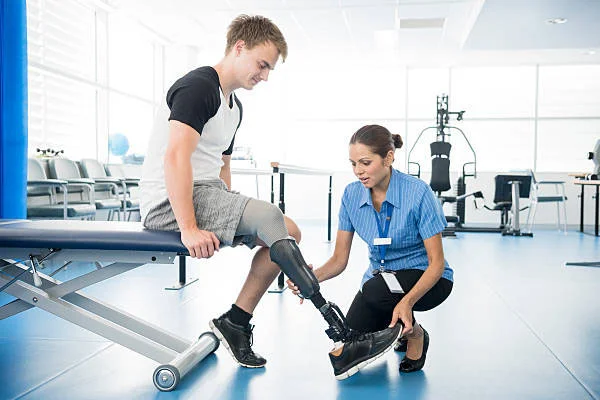
Need a prosthetic leg? Miembros Oasis Mobility Clinic offers custom artificial legs, prosthesis for legs, leg braces & full prosthetic support.
An artificial leg — also called a prosthetic leg or prosthesis for legs — is a medically engineered device designed to replace a missing or amputated limb. Whether you've lost a leg due to diabetes, a traumatic injury, vascular disease, or cancer, a modern prosthesis can restore your natural walking ability and quality of life.
Today's artificial legs are far more advanced than the traditional prosthetic leg most people picture. They are precision-engineered devices that mimic the biomechanics of a real leg, offering comfort, stability, and functionality that enables patients to live fully active lives.
✔ Below-Knee Prosthesis (Transtibial) — for amputations below the knee
✔ Above-Knee Prosthesis (Transfemoral) — for mid-thigh and hip-level amputations
✔ Partial Foot Prosthesis — for toe and partial foot loss
✔ Knee Disarticulation Prosthesis — for amputations at the knee joint
✔ Microprocessor-Controlled Prosthetic Legs — AI-powered adaptive limbs
✔ Sports & Activity-Specific Prostheses — for running, swimming, and dynamic movement
A prosthetic leg functions by connecting to your residual limb (the remaining part of your amputated leg) through a custom-fitted socket. This socket acts as the bridge between your body and the prosthesis. Every prosthetic leg is made of several key components that work together:
| Component | Function |
|---|---|
| Socket | Custom-molded to fit your residual limb precisely |
| Pylon (Structural Frame) | Provides the core structure and weight support |
| Prosthetic Foot & Ankle | Absorbs shock and enables natural gait movement |
| Knee Joint (if applicable) | Controls flexion and extension for above-knee users |
| Suspension System | Holds the prosthesis securely during movement |
| Prosthetic Liner | A silicone sleeve for comfort and skin protection |
Amputation can happen for many reasons. At Miembros Oasis Mobility Clinic, we serve patients from all walks of life, including those who have experienced:
✔ Diabetic complications leading to amputated leg procedures ✔ Peripheral artery disease (PAD) or vascular conditions ✔ Traumatic injuries from accidents or military service ✔ Bone cancer or tumors requiring surgical limb removal ✔ Congenital limb differences (born without a limb) ✔ Severe infections that couldn't be treated with limb salvage
Regardless of cause, our team evaluates every patient individually to determine the most appropriate prosthesis type, material, and design for your specific situation.
Many patients ask us about the difference between a leg brace and a prosthetic leg. Here's a clear breakdown to help you understand your options:
| Feature | Leg Brace / Legs Braces | Prosthetic Leg |
|---|---|---|
| Purpose | Supports an existing limb | Replaces a missing limb |
| Who Uses It | Patients with partial function | Amputees |
| Types | AFO, KAFO, hinged braces | Below-knee, above-knee, partial foot |
| Material | Plastic, carbon fiber, metal | Carbon fiber, titanium, silicone |
| Mobility Level | Moderate to high | High — designed for active use |
In some cases, patients may use both a prosthetic leg on one side and a leg brace or legs braces on the other side for additional prosthetic leg support. Our clinical team assesses each case to recommend the best combination.
We believe getting a prosthetic leg should never feel overwhelming. Our clear, patient-first process makes every step easy to understand:
Modern prostheses use state-of-the-art materials chosen for durability, lightweight performance, and skin compatibility. Here's what goes into a high-quality artificial leg:
✔ Carbon Fiber — Lightweight, strong, and energy-returning. Used in sports and dynamic prosthetic feet.
✔ Titanium — Exceptionally strong and corrosion-resistant. Ideal for structural components and connectors.
✔ Medical-Grade Silicone — Soft, skin-safe, and flexible. Used in prosthetic liners and cosmetic covers.
✔ High-Density Polyethylene (HDPE) — Used in sockets for a snug, durable fit.
✔ Thermoplastic & Laminated Composites — Used in custom-molded sockets for optimal fit and breathability.
💡 Did You Know? A properly fitted prosthetic leg doesn't just restore walking — it protects your joints, improves posture, prevents spine problems, and dramatically boosts mental wellbeing and confidence.
✔ Restores natural walking gait and everyday mobility
✔ Reduces strain on the opposite (sound) leg and joints
✔ Enables return to work, sports, and recreational activities
✔ Improves mental health, self-confidence, and independence
✔ Prevents secondary complications from prolonged wheelchair use
✔ Custom prosthetic leg support adapts to your unique body shape ✔ Modern prostheses are weather-resistant, with waterproof options available
At Miembros Oasis Mobility Clinic, we offer access to some of the most advanced prosthetic technology available today. These cutting-edge solutions go far beyond a traditional artificial leg.
Microprocessor-Controlled Knee Joints These intelligent prosthetic knees use real-time sensors and microprocessors to continuously adjust resistance with every step. Ideal for above-knee amputees who want the most natural walking experience possible.
Myoelectric & Sensor-Driven Prostheses Using electrical signals from your residual muscles, myoelectric prostheses respond directly to your body's movement intent. This creates a more intuitive, natural prosthesis experience.
Energy-Storing Carbon Fiber Feet These dynamic prosthetic feet store energy as you walk and release it for a spring-like push-off — mimicking how a natural ankle works. Perfect for active patients and those who want to return to running or sports.
Waterproof & Activity-Specific Designs We offer waterproof prosthetic legs for swimming and showering, as well as sport-specific prostheses designed for cycling, hiking, and running.
How long does a prosthetic leg last?
On average, a prosthetic leg lasts 3 to 5 years, depending on activity level, weight, and how well it is maintained. Sockets may need replacement sooner as the residual limb changes shape over time.
Is a prosthetic leg painful to wear?
A properly fitted artificial leg should not be painful. Some initial discomfort is normal during the adjustment period, but persistent pain is a signal to visit your prosthetist for a socket adjustment.
Can I shower or swim with my prosthetic leg?
Not all prostheses are waterproof. We offer specially designed waterproof prosthetic legs and separate shower limbs for patients who need them. Ask our team about your specific options.
How soon after amputation can I get a prosthesis?
Most patients are fitted with a preparatory (temporary) prosthetic leg within 4 to 8 weeks of amputation, once the residual limb has healed and stabilized. Early fitting leads to better long-term outcomes.
Does insurance cover a prosthetic leg?
Many insurance plans, including Medicare and Medicaid, provide coverage for medically necessary prosthetic legs. Our team works with your insurance provider to navigate coverage, prior authorizations, and appeals. Contact us to verify your benefits.
What's the difference between a prosthetic leg and a leg brace?
A leg brace (also called an orthosis or legs braces) supports and stabilizes an existing limb that still has partial function. A prosthetic leg replaces a limb that has been amputated. Some patients use both — a prosthesis on one side and a leg brace on the other for complete prosthetic leg support.
Miembros Oasis Mobility Clinic is staffed by board-certified, ABC-credentialed prosthetists with over 20 years of combined clinical experience. We are dedicated exclusively to prosthetics and orthotics — this is all we do, and we do it with precision and passion.
✔ ABC-Certified Prosthetists & Orthotists (CPO)
✔ Accredited facility meeting national clinical standards
✔ Hundreds of successful prosthetic fittings annually
✔ Multi-disciplinary team including physical therapists and rehabilitation specialists
✔ Ongoing clinical education and training in the latest prosthetic advancements
✔ Trusted by physicians, hospitals, and rehabilitation centers
Whether you are newly amputated, replacing an outdated prosthesis, or exploring options for a loved one — our team is here to guide you every step of the way. From the first consultation to long-term prosthetic leg support, Miembros Oasis Mobility Clinic is your partner in mobility.
📞 Call Us Today for a Free Consultation Our friendly clinical team will answer your questions, verify your insurance coverage, and schedule your initial evaluation — usually within 48 hours.